Japandi Decor: 7 Calm Rules for a Warmer Minimal Home
AUDIO SUMMARY: Japandi decor blends Japanese calm with Scandinavian warmth: low furniture, natural wood, warm neutrals and a single branch in a vase instead of clutter. This guide explains the palette, the materials and seven rules, then walks room by room through four real homes.
Japandi decor is the quietest trend in interiors, and that is exactly why it works. It blends Japanese minimalism with Scandinavian warmth: clean lines and empty space from Japan, soft textures and natural wood from Scandinavia, and a firm rule that everything in the room earns its place. This guide explains what the style is, the palette and materials that make it work, seven rules for getting it right, and then walks room by room through four real homes from the source gallery behind this article.
What Is Japandi Decor?
At its simplest, japandi decor is a hybrid: the name joins Japan and Scandinavia, and the style joins their shared love of simplicity, functionality, natural materials and craftsmanship. The Japanese half brings restraint, low furniture, and the philosophy of wabi-sabi — the appreciation of imperfection, natural ageing and quiet beauty. The Scandinavian half brings hygge, the feeling of cosiness and contentment, plus pale woods, soft textiles and light. Our guide to japanese decor covers the Japanese side on its own, and the two styles share more than they differ on: both believe a room should be calm, useful and honest about its materials.
One thing worth saying plainly: Japandi is a Western coinage, not a Japanese tradition. Nobody in Kyoto grew up calling their home Japandi. It is a modern blend, put together by designers who noticed how naturally the two traditions fit, and it works best when you treat it as a set of principles rather than a shopping list. The four homes in the source gallery show that range well: the first revels in natural wood tone and botanics, the second cuts sharper with bolder outlines and contrast, the third is minimalist and mild, and the fourth goes for sophisticated wow factor — and all four are unmistakably the same style family.
The Palette: Warm Neutrals With One Dark Note
The japandi decor palette is warm, muted and narrow. Think warm off-whites, soft beige, oat, clay, dusty taupe and sage, with honey wood tones doing most of the colour work. Walls stay pale so the wood can carry the warmth, and a single dark note — a matt black accent, a charcoal cushion, a black kitchen island — gives the room its contrast and stops the neutrals from going flat. In the second home in the gallery, that contrast is the whole drama: cream stucco walls and a grey sofa against a wall of warm wood, with bold matt black accents punctuating the powder room’s creamy walls, mini sink and simple mirror.
Keep pattern out of the palette almost entirely. Pattern in this style comes from weave and grain — a monochrome Scandinavian rug spreading bold pattern across a small lounge area, the grain of a wood dining table, the texture of a jute rug — not from prints.
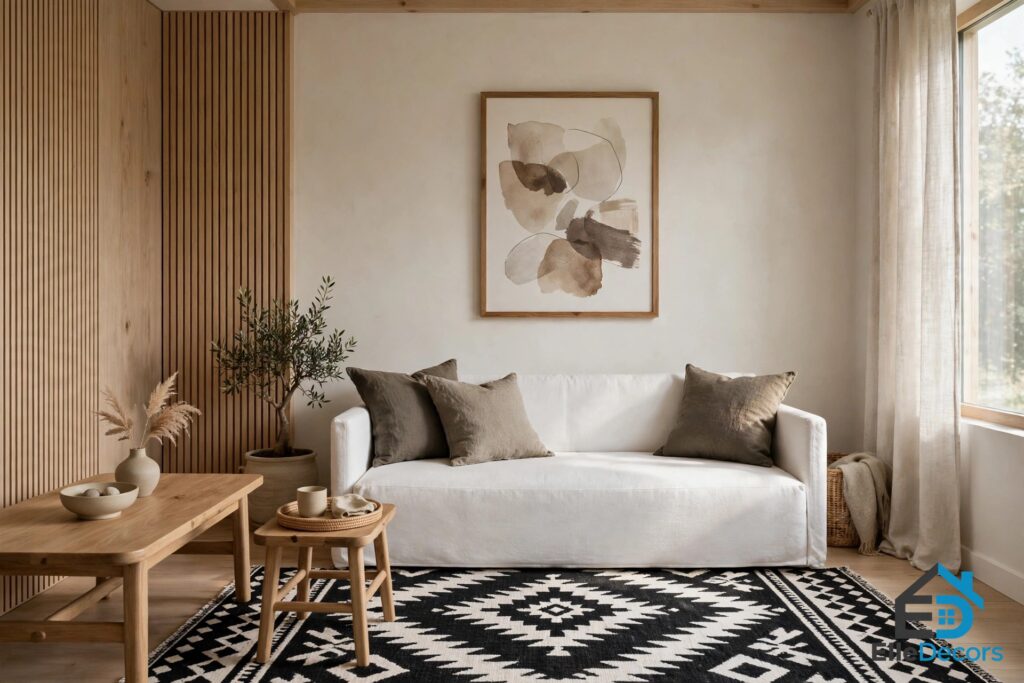
In the first home, abstract artwork above the small sofa sets the colourway instead: dark beige scatter cushions on the white couch pick up the art’s rich neutrals and link visually with the natural wood tone around the room. One piece of art, one echo in the textiles, and the room is done.
Materials That Do the Talking
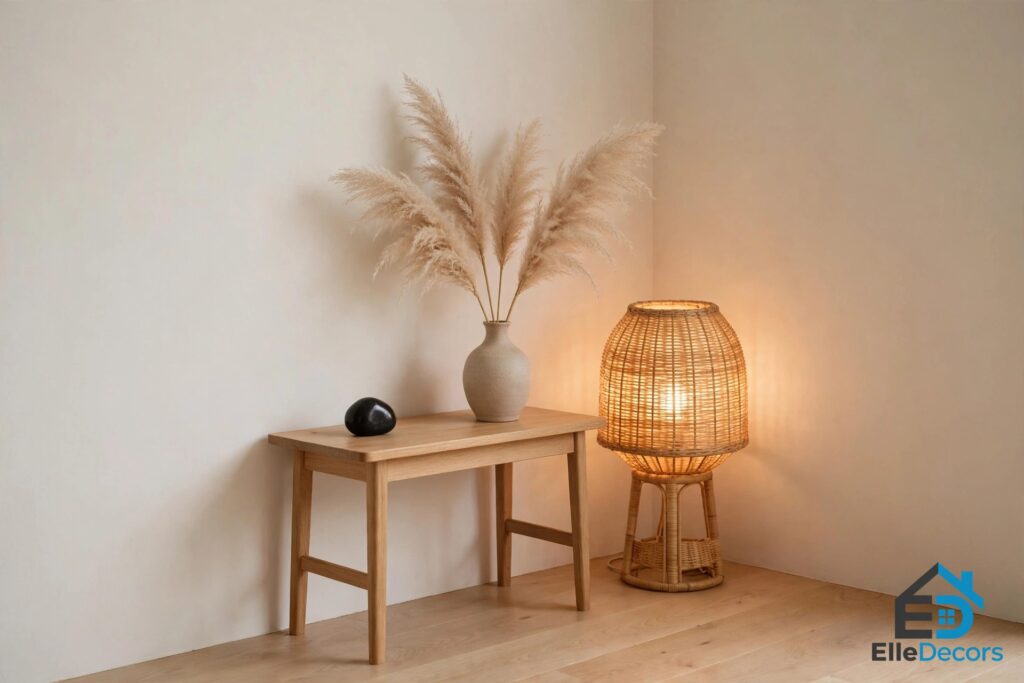
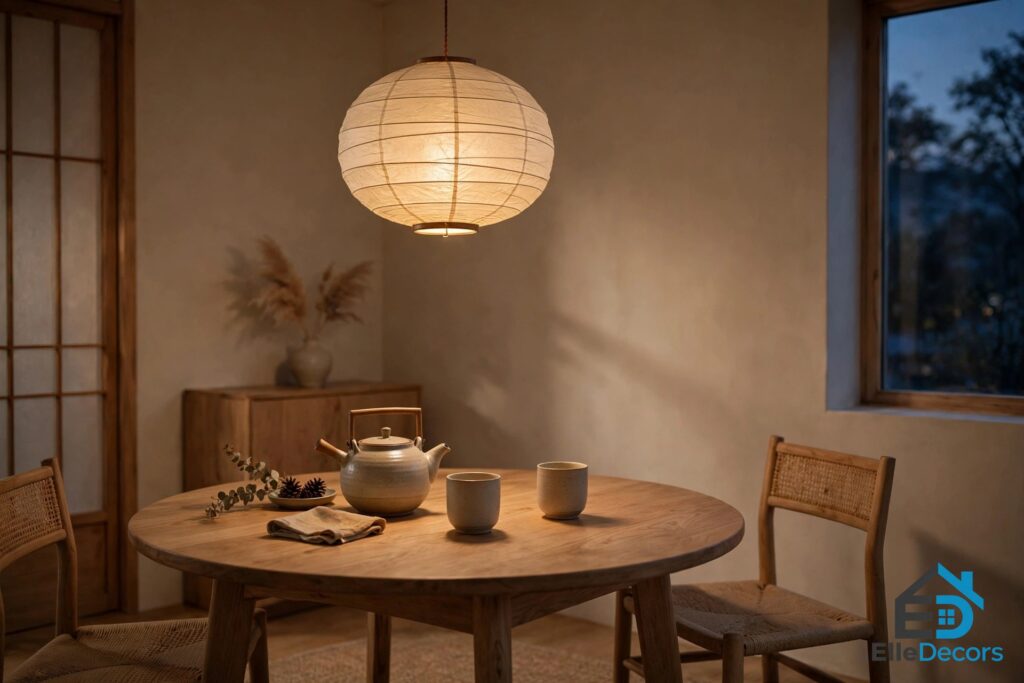
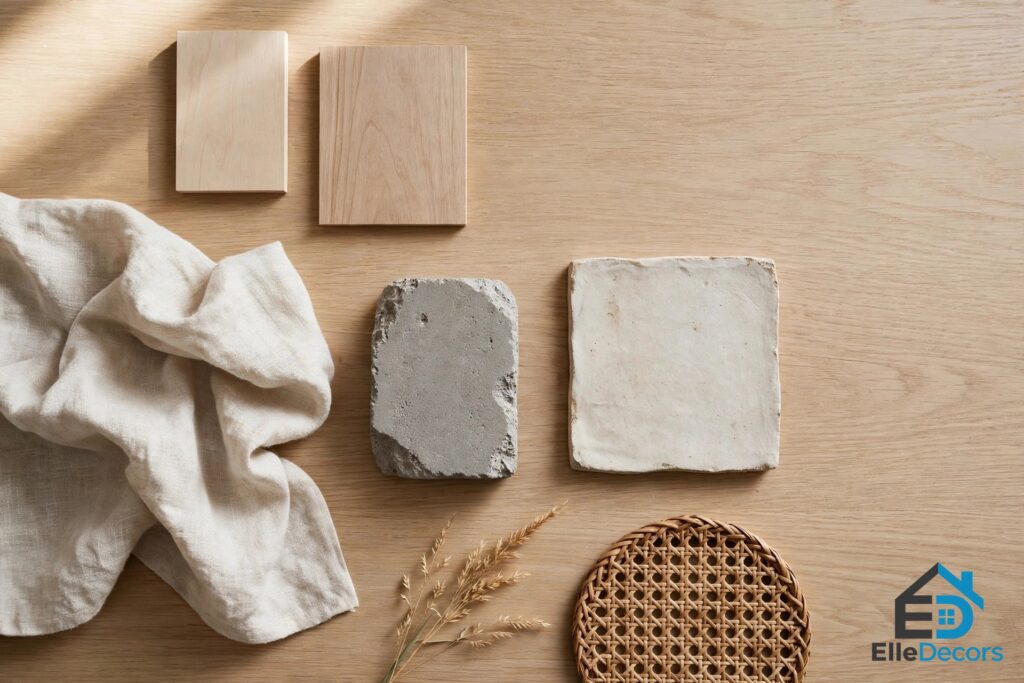
If the palette is quiet, the materials are the conversation, and the materials that make japandi decor feel warm rather than bare are always natural and tactile. Light woods lead — oak, ash and pale timber for floors, tables, shelving and staircases — followed by linen, cotton, rattan, stone, clay ceramics and paper. The source homes use all of them: a wood and stone coffee table dressed with books, a rustic fruit bowl as the dining table’s only centrepiece, a rattan floor lamp glowing beside a console table, and a Japanese-style paper lantern hanging over the dining area.
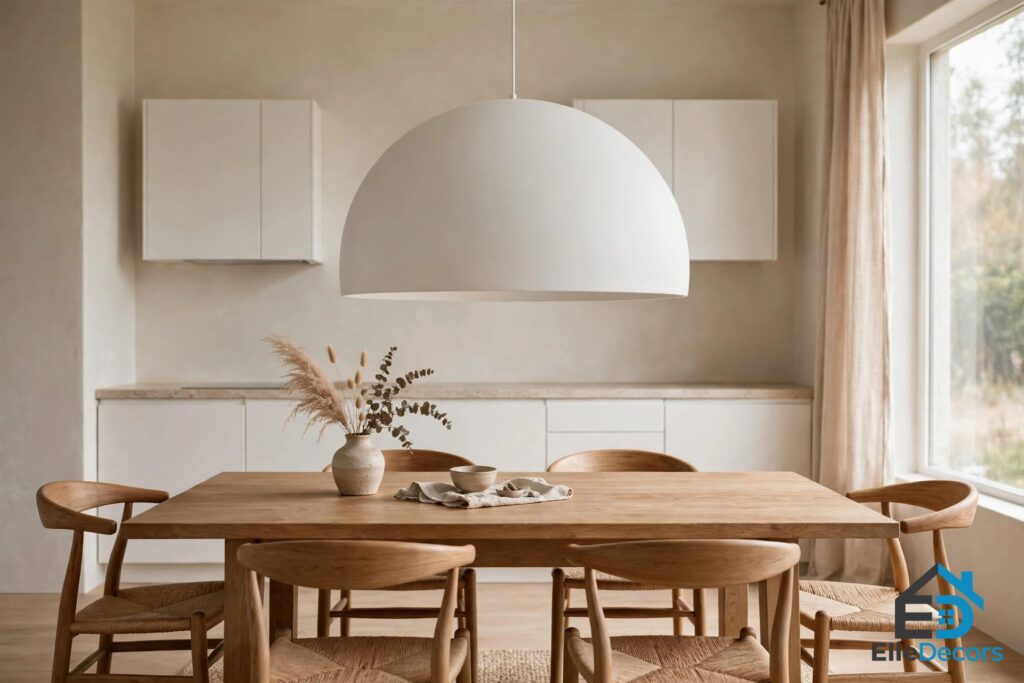
That paper lantern is worth naming: it is the Formakami JH5 pendant by Jaime Hayón for &Tradition, a modern take on the Japanese paper lantern, and it shows how the style treats light as a material. The oversized dining pendant in the first home stays understated in solid white, blending with a row of white kitchen wall units while the wood dining table merges visually with the natural wood base units. Light should be soft, layered and warm — floor lamps at eye level, wall lights in the hallway, a tripod lamp in the corner — never a single harsh ceiling fixture.
Avoid synthetic and lacquered surfaces wherever you can. Shiny plastic, high-gloss lacquer and fake wood grain all fight the style, because every surface in a Japandi room is on display and there is no clutter to hide behind. The rule from the gallery’s second home is a good test: a kitchen island elevated on slender legs to lighten its bulk, built-in units in mellow wood tone wrapping a black island, and a materials mood board pinning the whole scheme to wood, stone and linen before anything is bought.
Our guide to the best use of wood in modern designs goes deeper on choosing timber that ages well instead of dating fast.
Low Furniture, Open Layouts
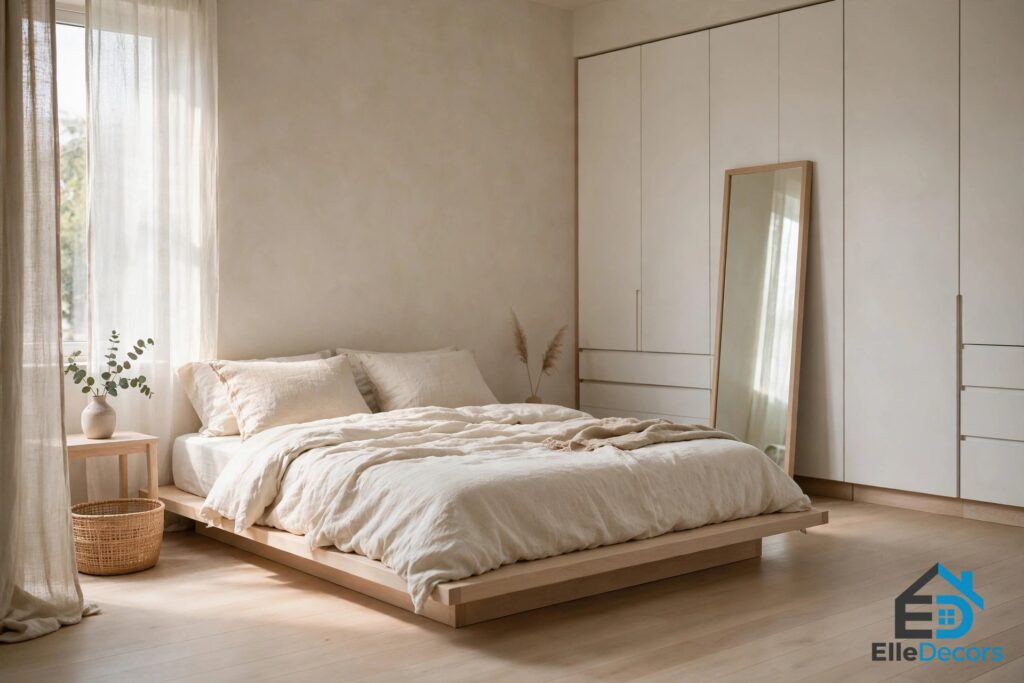
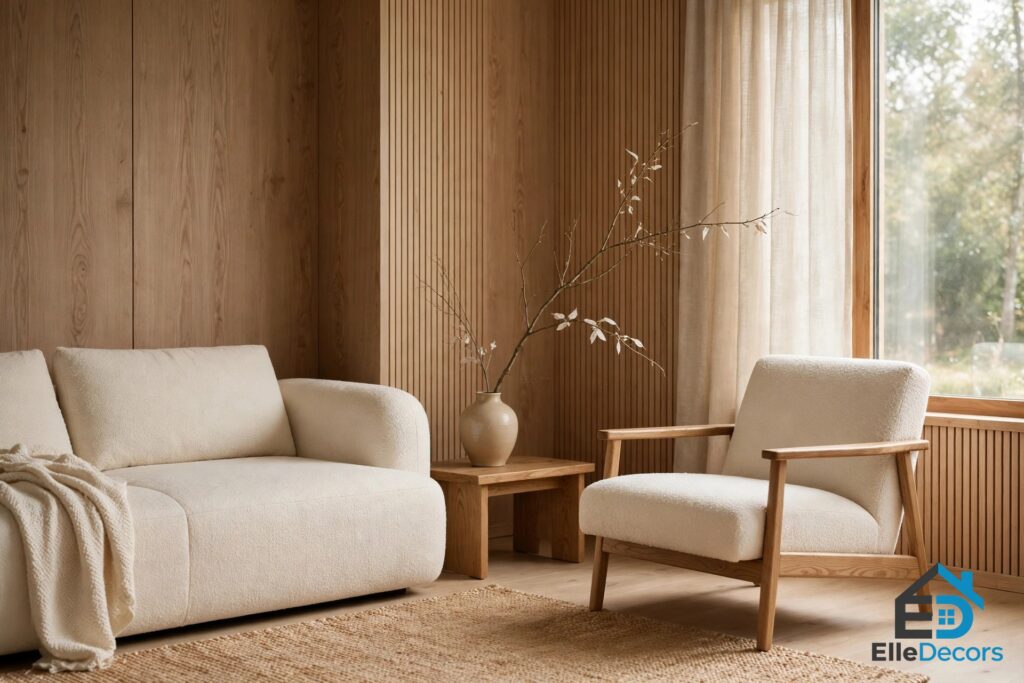
Low furniture is where japandi decor shows its Japanese roots most clearly. Sofas sit low, beds are platform beds, coffee tables are narrow rectangles that dart through a compact lounge, and dining chairs have curved backs that embrace the rounded edges of the table. In the gallery’s second home, a custom-made platform bed with storage is crafted to match the length of the bedroom wall exactly, with white wardrobes marching toward a height-matched wall mirror that doubles the length of the storage run. Nothing is tall for the sake of it; height is earned by function.
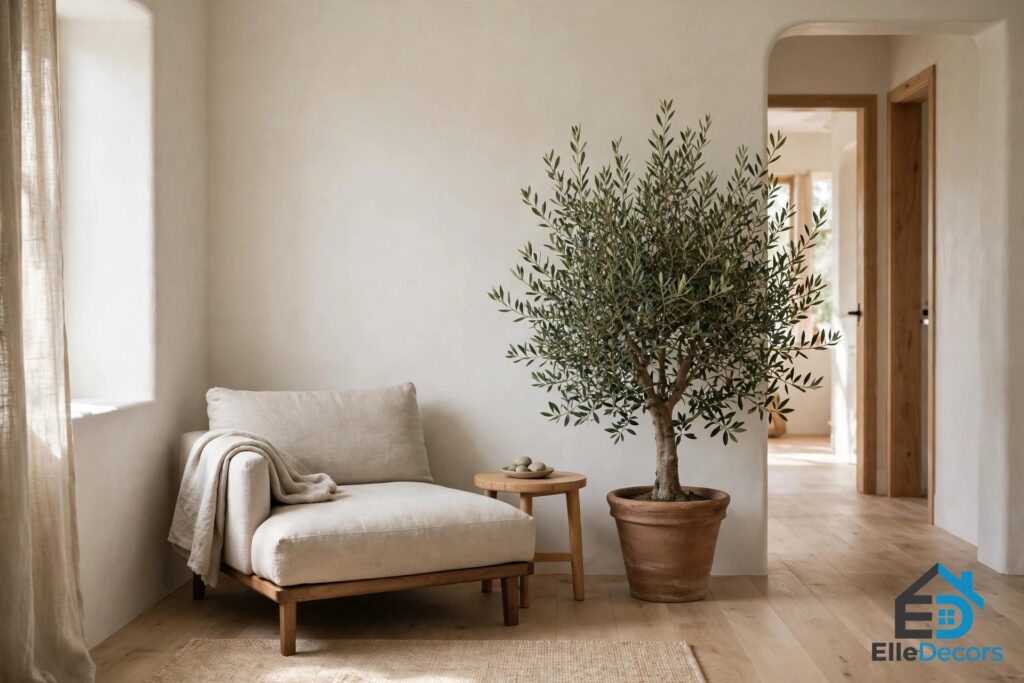
Layouts stay open and flowing. The first home’s white living room walls double as a fuss-free projector screen, the lounge chair, small side table and mature indoor plant slot into the transition space between areas to form a reading nook, and pocket doors join the dining area to the kitchen so rooms can open or close as the day needs.
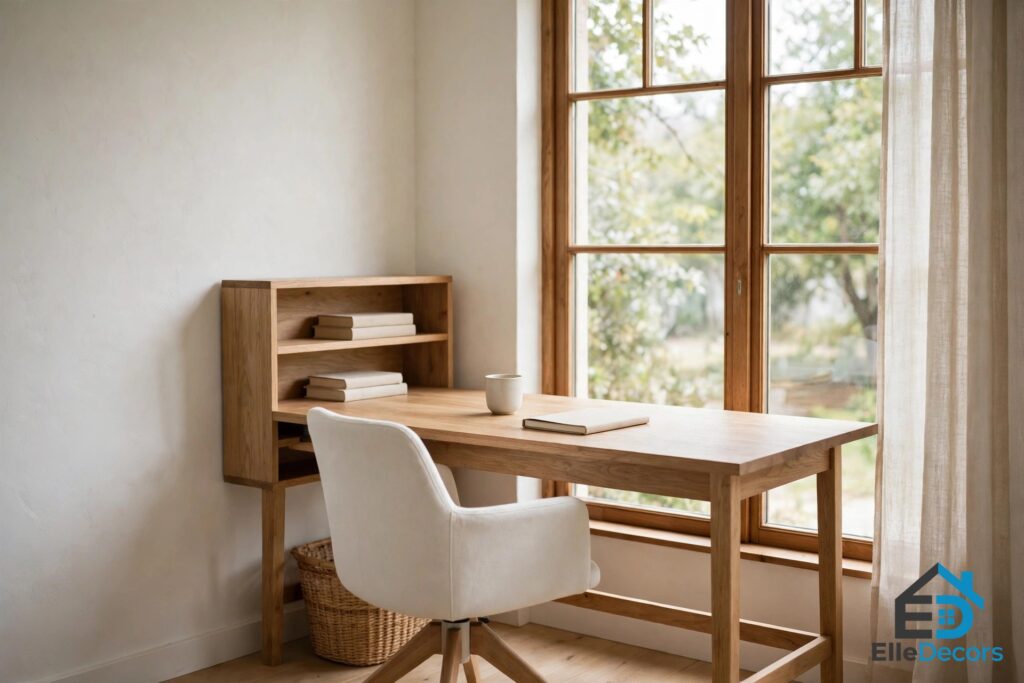
A home workspace wraps around one side of a bedroom, a white swivel chair contrasting with a natural wood desk, and double workspaces sit by the windows in the second home to make the most of natural light, with a bookshelf fluently adjoined to complete the edge-to-edge installation. The Scandi style in our guide to Scandinavian rooms follows the same logic: furniture that serves everyday routines quietly, without demanding attention.
7 Rules for a Calmer Home
These seven rules distil japandi decor into habits you can use in any room, whether you are starting from scratch or editing a room you already have.
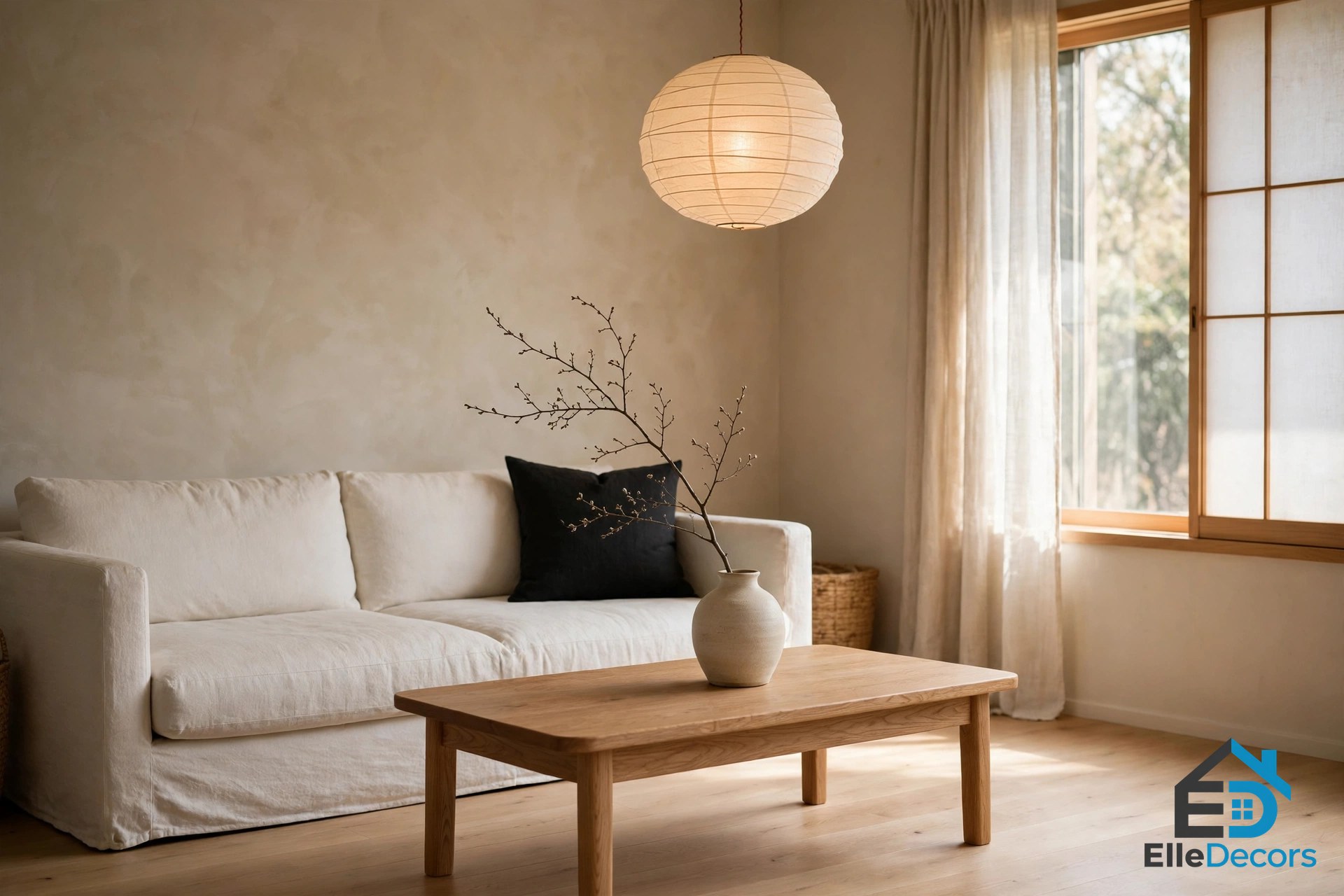
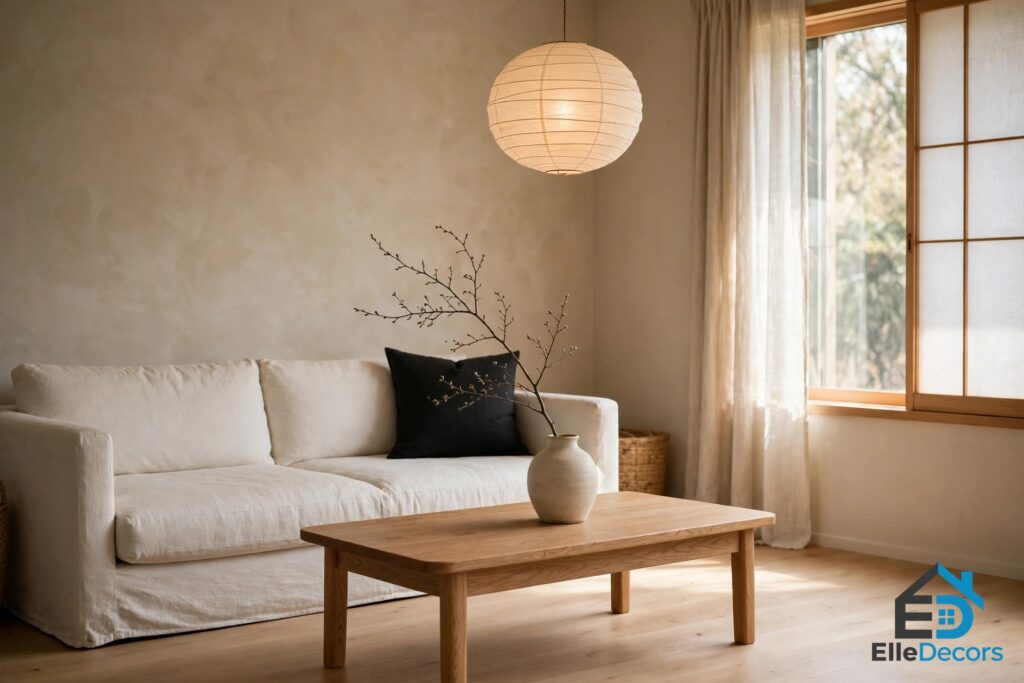
- Keep one considered piece per surface. A bud vase and pampas arrangement on a small console table, a decorative vase holding a single branch, a Japanese teapot on the table — one object, given space, beats five objects crowded together.
- Pair warm wood with one dark note. Honey wood tone plus a matt black accent — a black island, a black faucet, black chair frames — is the contrast that keeps warm neutrals from looking washed out.
- Choose texture over pattern. Linen, rattan, jute, raw concrete and wood grain give a room its interest. In the second home, raw grey concrete floods the floor from lounge to kitchen, and the texture alone carries the space.
- Go low and grounded. Low sofas, platform beds, a shapely contemporary stool at the dining table instead of a tall chair — furniture that sits close to the floor makes a room feel settled.
- Light with paper and warm bulbs. A paper lantern over the dining table, a rattan floor lamp in the corner, wall lights down the hallway: soft, layered, warm light is the style’s jewellery.
- Bring in one branch, not a bouquet. Plant arrangements expand on the colour theme set by the art in the lounge, but a single branch in a vase or one mature indoor plant is the Japandi way. Greenery should look gathered, not arranged.
- Leave deliberate empty space. A deliberately empty wall, a clear stretch of floor, a shelf with nothing on it — empty space is not unfinished, it is the point. If a surface holds more than two objects, take one away.
Room by Room: Four Homes, Four Lessons
Room by room, japandi decor changes its emphasis but never its rules: the living room edits down to one artwork and one rug, the kitchen to one island and one bench, the bedroom to one bed and one clear surface.
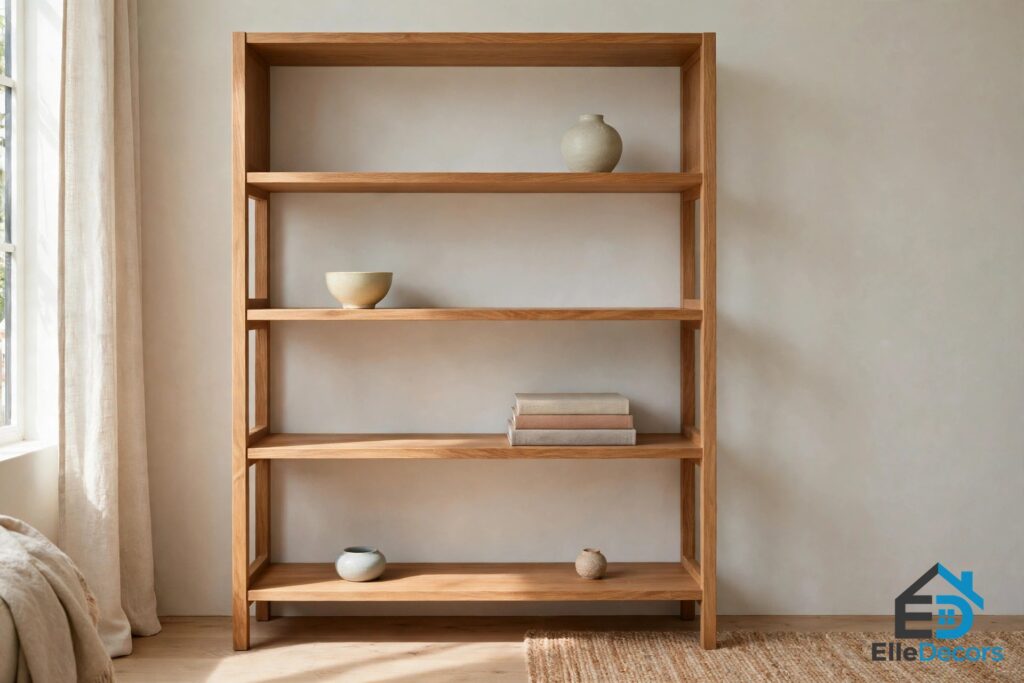
The living room is where the style is easiest to read. In the first home, the abstract artwork sets the scheme, the monochrome rug defines the lounge inside the open plan, and the modern wooden bookshelf is lightly accessorised with small, elegant decorative items that neither demand attention nor clutter the airy interior. In the third home, the umber artwork is colour-matched by a modern floor lamp beside the cool cream modular sofa and ottoman, and a lounge chair crisply matches the cream upholstery while tying in with the soothing wood grain of the wall panels. The lesson is the same in both: one artwork, one rug, one wood tone, and the room is finished.
The kitchen follows the same discipline at a smaller scale. The first home’s white kitchen units and worktops make a small kitchen look much larger than its restricted dimensions, while the oversized white pendant hangs low over the wood dining table.
The second home’s kitchen island stands on slender legs and the built-in units draw around the black island in mellow wood tone. A bespoke bench carves an L-shaped dining nook into one corner, adding warming wood tone to a cool white scheme, and the white kitchen ends at a wood slatted screen that marks the entryway.
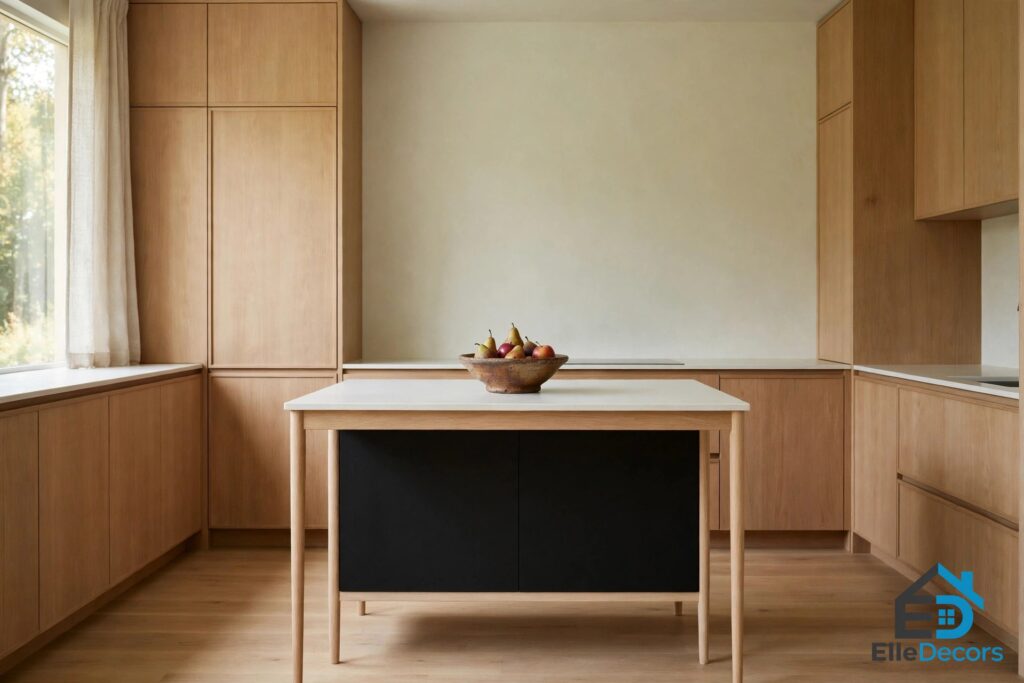
The designer of the second home is Norm Architects, the Copenhagen studio whose work shapes much of the modern Japandi look, and their approach shows here: tall bespoke cabinetry that accentuates the ceiling height, and a jute rug that complements the honey wood tone of the double-banked units.
The bedroom is where the style is easiest to get right, because the room already wants to be quiet. The platform bed with storage, the white wardrobes, the mirror doubling the storage run, and the workspace tucked around the side show how a small room can hold a lot without looking full. The second bedroom is almost an exact mirror image of the first, with a swivel chair pulled up to a custom desk with a bookcase fashioned underneath it. Keep the bedding linen, the palette warm white and wood, and the surfaces nearly clear.
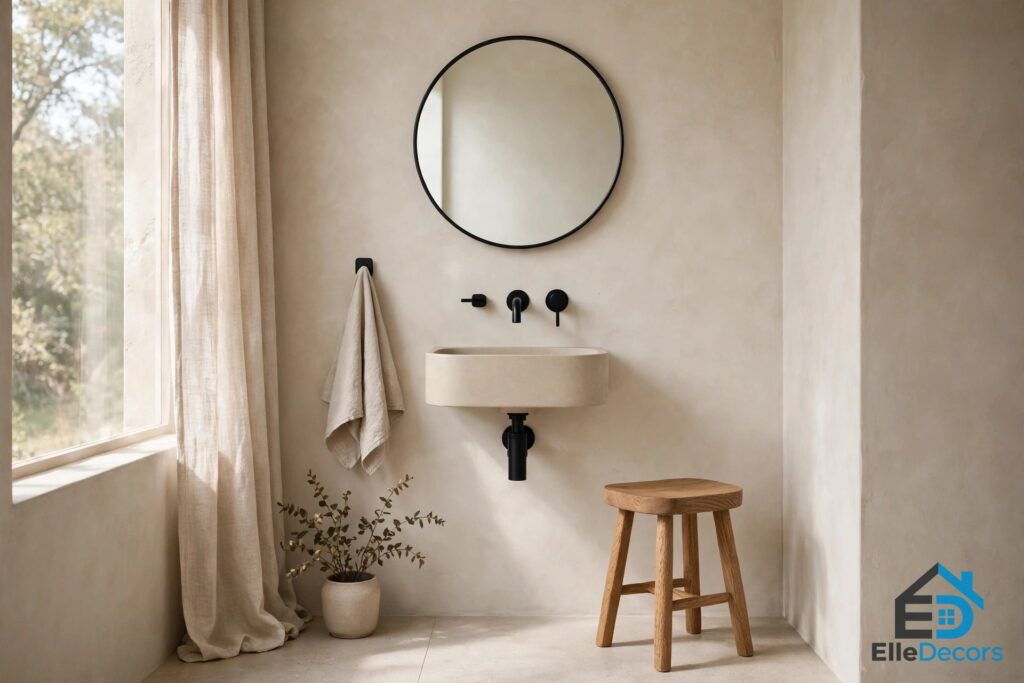
The bathroom closes the tour with the simplest palette of all: white and beige, with bold matt black accents in the powder room. A wall-hung toilet, a mini bathroom sink and a simple bathroom mirror are all the room needs, because the materials — pale stone, warm wood, matt black — do the work that tiles and accessories would do elsewhere.
Quick Guide: Each Room at a Glance
| Room | Key piece | Material to lead with |
|---|---|---|
| Living room | Low linen sofa, one artwork | Light wood, wool rug |
| Dining room | Wood table, paper lantern | Oak, paper, ceramic |
| Kitchen | Island on slender legs | White units, wood tone |
| Bedroom | Platform bed with storage | Linen, pale timber |
| Bathroom | Wall-hung fittings, mini sink | Stone, matt black |
| Home office | Desk by the window, swivel chair | Natural wood, white |
Watch: A Calm Japandi Home, Room by Room
Watch a full home tour of a renovated flat in Hougang, Singapore, designed around a warm Japandi palette of light wood tones, soft textures and integrated lighting. The tour shows the ideas from this guide in a real, lived-in home: a kitchen that can be fully enclosed during heavy cooking while a full-height glass partition keeps the visual connection to the living and dining areas, and lighting layered into the architecture itself rather than hung on it. The design is by i.Poise Interior Design.
Video: A calm Japandi home tour in Hougang, Singapore, by i.Poise Interior Design.
Frequently Asked Questions
What is japandi decor?
Japandi decor is a hybrid interior style that blends Japanese minimalism with Scandinavian warmth. It uses warm neutrals, natural materials like light wood, linen, rattan and stone, low furniture, and very little decoration — every object in the room has a function, and empty space is part of the design.
Is Japandi the same as minimalism?
No. Minimalism can be cold and stark, while Japandi is warm minimalism: it keeps the clean lines and empty space but adds soft textures, warm wood tones and cosy details like linen cushions, paper lanterns and plants. The Scandinavian hygge influence is what makes it feel like a home rather than a gallery.
What colours work in a Japandi room?
Warm off-whites, beige, oat, clay, dusty taupe and sage, with honey wood tones and one dark note such as matt black for contrast. Avoid bright colours and busy patterns; colour should come from natural materials and a single piece of art.
Can I do Japandi on a budget?
Yes, because the style asks you to buy less. Start with the palette and the clear-out: remove everything that has no function, then add one warm wood piece, linen textiles and a single branch in a vase. A paper lantern and a low platform bed frame change the room more than a dozen small accessories would.
The Bottom Line
Japandi works because it is a philosophy before it is a look: keep what is natural, tactile and useful, and leave space around it. Start with the warm neutral palette, choose light wood and linen over shine and pattern, sit low, light softly, and let one branch and one artwork do the decorating. The four homes in this guide prove the same point four different ways — calm is not empty, it is edited.