Ceiling Fans Contemporary: 8 Picks That Look Designed, Not Dated
Audio Summary
A ceiling fans contemporary buyer faces a strange problem. The fan is the biggest object on the ceiling, visible from the sofa, the dining table, and the bed. A bad one ruins the room; a good one disappears into the design until you need the breeze. This guide does both jobs: first, how to choose — size, blade span, motor, light, and mounting; then eight fans you can buy right now, each checked on the page that sells it. Prices are left out on purpose, since they change often.
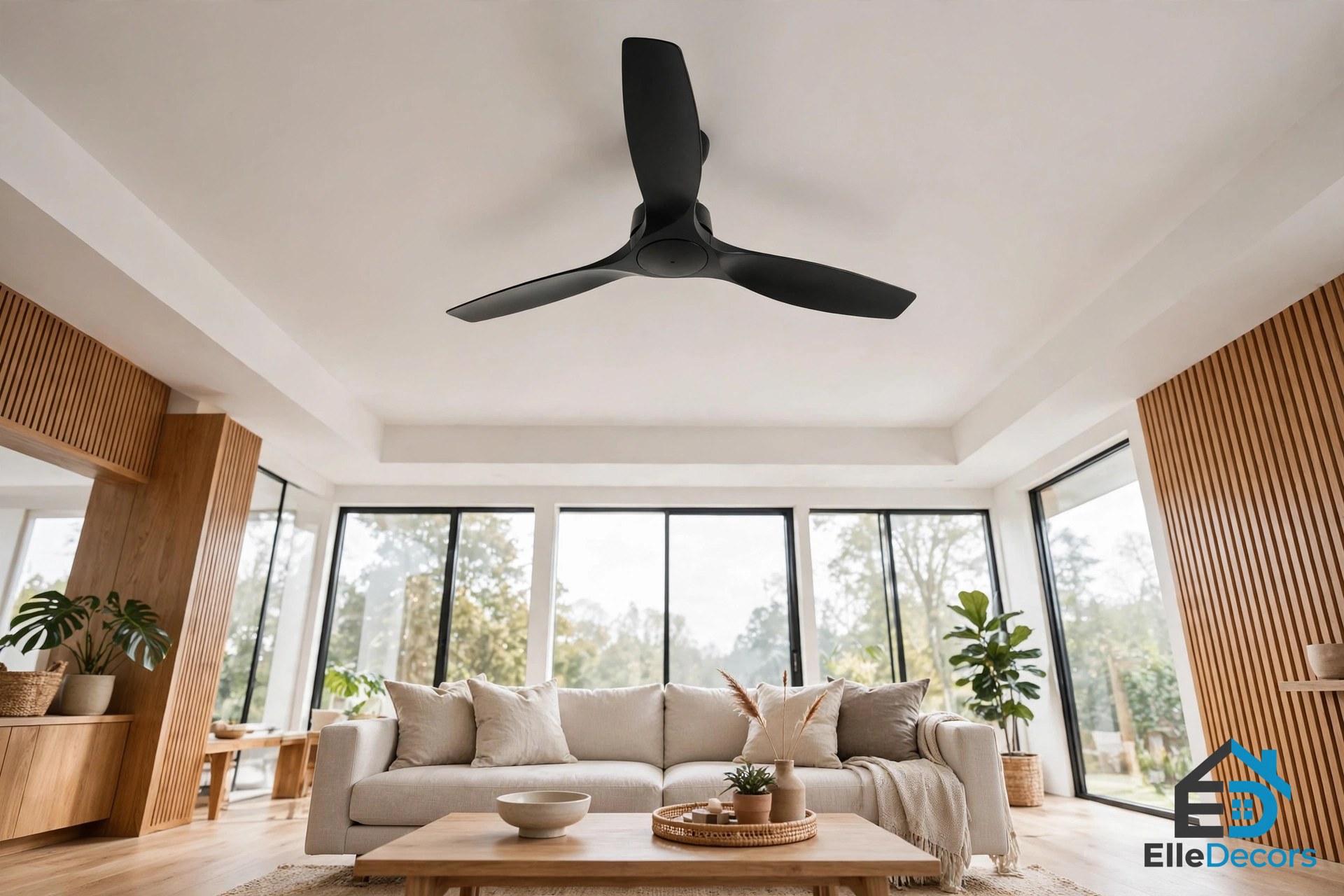
Buying Guide: Ceiling Fans Contemporary Style
Size and Blade Span First
Size comes first when you shop for ceiling fans contemporary style, because the wrong span is the mistake people regret most. Measure the floor area first, splitting an L-shaped room into two rectangles, then match the blade span to the room. Up to 75 square feet takes a 29 to 36 inch fan; 76 to 144 takes 36 to 44 inches; 145 to 225 takes 44 to 50 inches; 226 to 400 takes 52 to 60 inches; over 400 takes 60 to 72 inches, or two fans spaced along the length. A 52 inch fan fits most living rooms, which is why it is the default size.
In a long, narrow room, two smaller fans beat one huge fan in the middle. In a room with a big table, centre the fan over the table rather than over the geometric centre of the room, as you would a pendant.

How Low Should It Hang?
Hang the blades 8 to 9 feet above the floor, never below 7 feet — that rule sets the mount type and the downrod length. On an 8 foot ceiling, only a flush mount works: the box sits at 8 feet, the body takes roughly 10 inches, and any downrod drops the blades under the 7 foot line. A 9 foot ceiling takes a 6 inch downrod, a 10 foot ceiling takes 12 inches, and a 12 foot ceiling takes 24 inches.
Blade tips want at least 18 inches from the nearest wall, and 24 inches is better: a fan close to a wall churns instead of moving air and makes a low thrumming noise. If your room cannot give a 52 inch fan that margin, the answer is a 44 inch fan, not a shorter downrod.
DC or AC Motor?
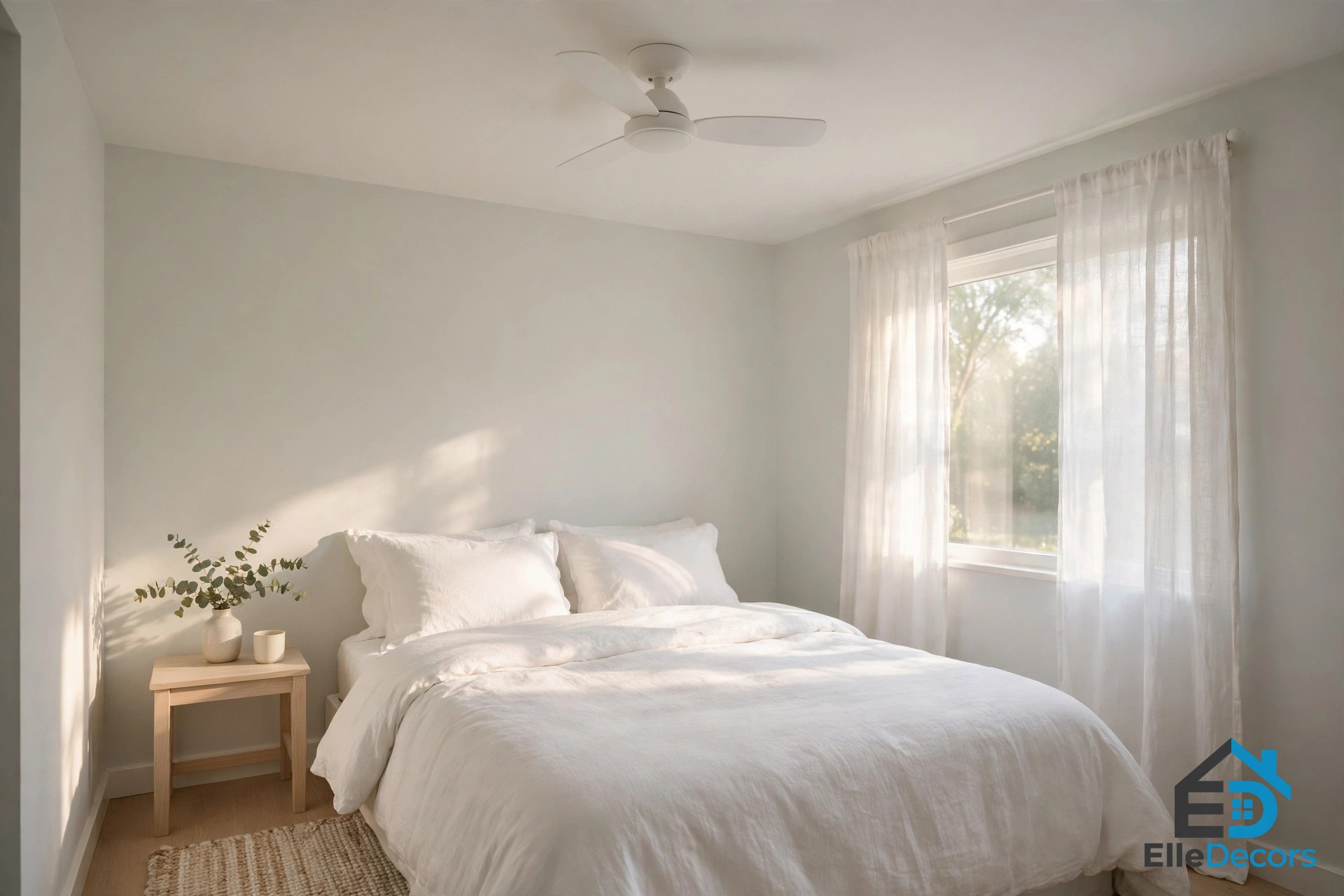
A DC motor is the quiet upgrade most ceiling fans contemporary buyers should ask for, especially in a bedroom. DC motors are significantly smaller and lighter than traditional AC motors, which lets makers build a much slimmer housing — the foundation of the contemporary look. They also run quieter, offer more speeds at the low end, and use up to 70 percent less energy than AC motors. An AC motor is proven, simple, and often cheaper, but over a bed a DC motor is worth paying for.
Compare airflow efficiency in cubic feet per minute per watt, the Energy Star figure measured the same way for every fan.
Light: Built In or Separate?
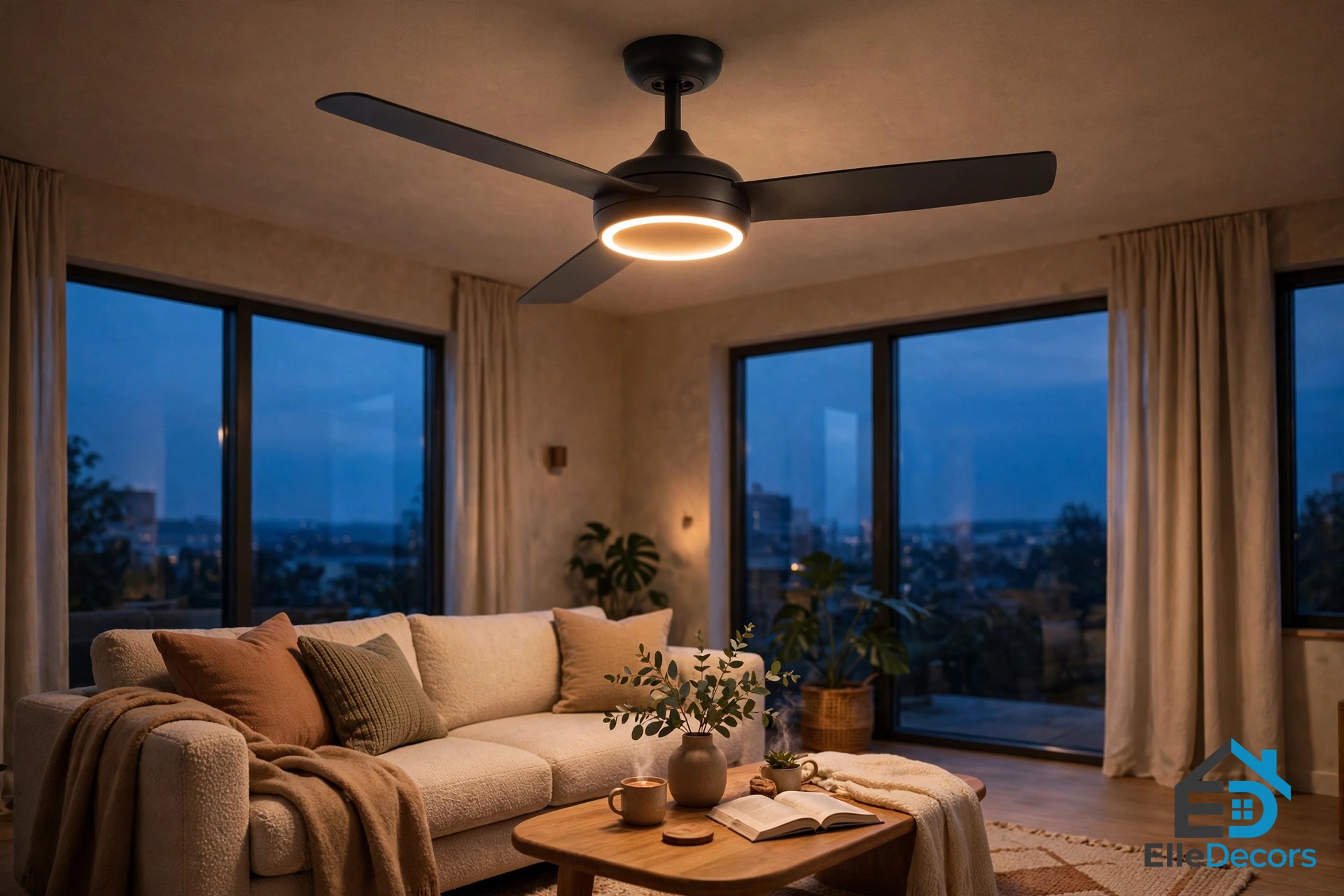
The light question decides the whole look. A fan with no light kit suits a room that already has downlights or lamps, and it keeps the ceiling clean. A fan with an integrated LED suits a room with exactly one ceiling box, where the fan must do both jobs. Modern fans integrate the LED into the housing, flush with the motor. Look for a dimmable LED: around 3,000K gives a warm, cozy ambience, while higher values suit large living or work spaces.
A swing arm lamp beside the reading chair gives you task light at seat level, so the fan light only has to wash the room.
Damp, Wet, or Indoor Only?
The rating matters more than the brand for any fan that goes outside. A damp rated fan belongs in a covered spot where rain never lands on it, such as a porch with a solid roof or a screened patio. A wet rated fan is sealed for direct exposure on a pergola or open deck. An indoor-only fan belongs indoors. Check the rating on the maker page before you buy.
Blades, Finishes, and the Contemporary Look
Three or four blades read sleeker than five, because there is less visual weight spinning overhead. Matte black and brushed nickel remain the most popular finishes, because they coordinate with most interior hardware without shouting. Wood blades — walnut, white oak, or a warm natural tone — soften a minimal room and pair well with wood furniture. The design rule that holds across the best rooms is simple: one finish, three blades, and no light kit unless the room has no other ceiling light.
A compact fan suits a studio flat far better than a full-size one. Our studio flat furnishing ideas guide covers how a small space stays calm when every piece earns its footprint, and the fan is no exception.
The 8 Picks, Grouped by Job
The eight ceiling fans contemporary picks below were each checked on the page that sells them, so sizes and ratings are what the makers state. We left prices out on purpose, since they change often.
The Sculptural Statement
Modern Fan Co Ball Flush
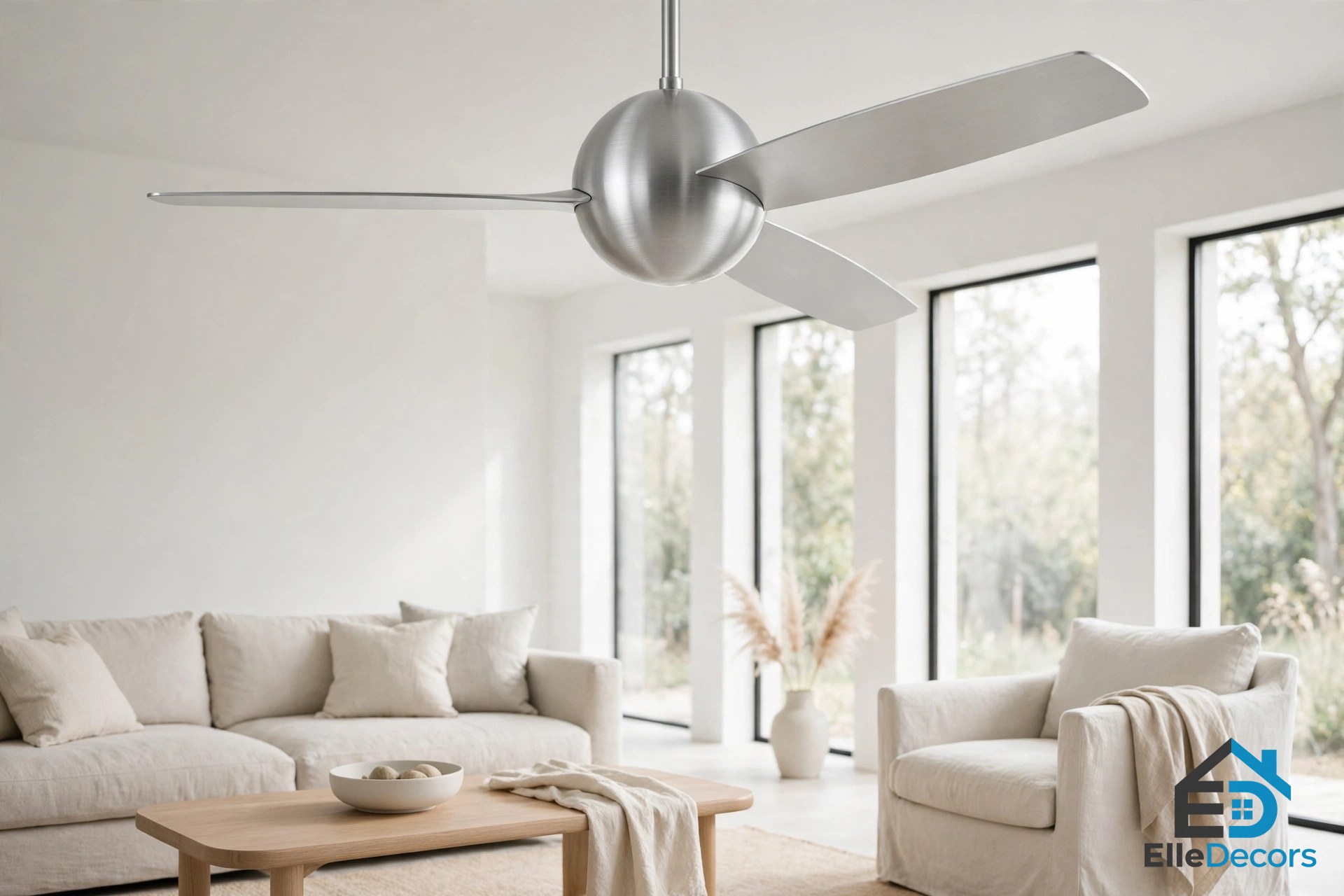
The Ball is the fan for a room where the fan is allowed to be seen. Modern Fan Co builds it around a spherical motor housing, a piece of pure geometry from designer Ron Rezek, with three flat blades extending from the ball. The flush version mounts close to the ceiling. Lightopia lists the 42 inch flush version in brushed aluminum or gloss white, with aluminum, maple, or white blades, and the maker rates it for damp locations, so a covered porch is fair game too. Pick it for a minimal room where the fixture is part of the design.
View the Ball Flush Ceiling Fan at Lightopia
The Big-Room Workhorse
Visual Comfort Maverick 60 LED
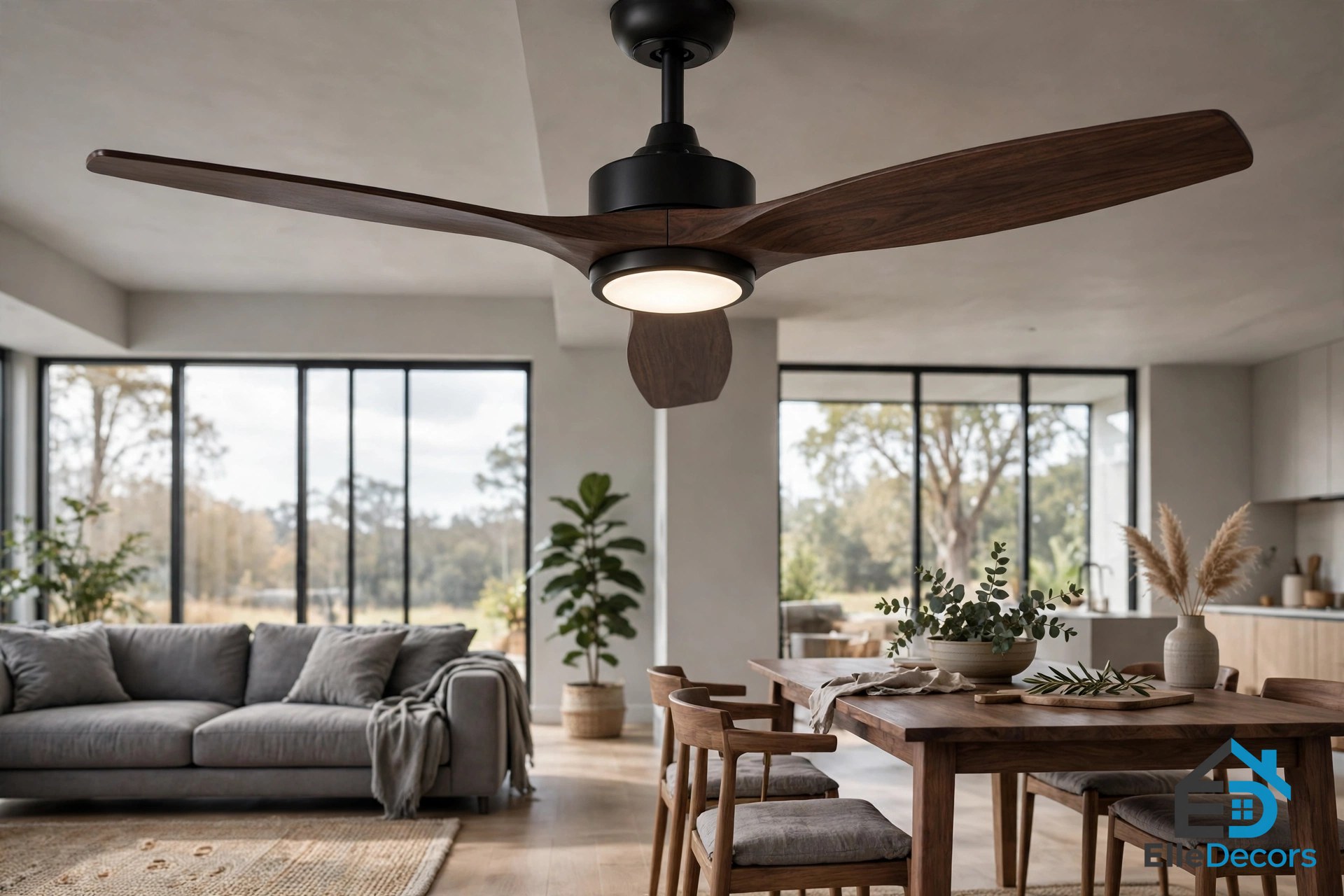
The Maverick is the fan for most real living rooms, because it comes in the large sizes an open plan needs. The LED version is 60 inches across, with three wide, slightly pitched blades in hand-carved dark walnut on a matte black steel body. A DC motor runs six speeds with a hand remote, and the integrated LED gives 1,100 lumens of warm 3,000K light through an opal etched glass shade, fully dimmable from the same remote.
It is damp rated and ENERGY STAR qualified, with a 6 inch downrod included. The seller lists airflow up to 7,680 cubic feet per minute at high speed. It is the biggest ceiling fans contemporary statement in this guide, and the right one when the room is large enough to carry it.
View the Maverick 60 LED Ceiling Fan at Bees Lighting
Low Ceilings, Done Right
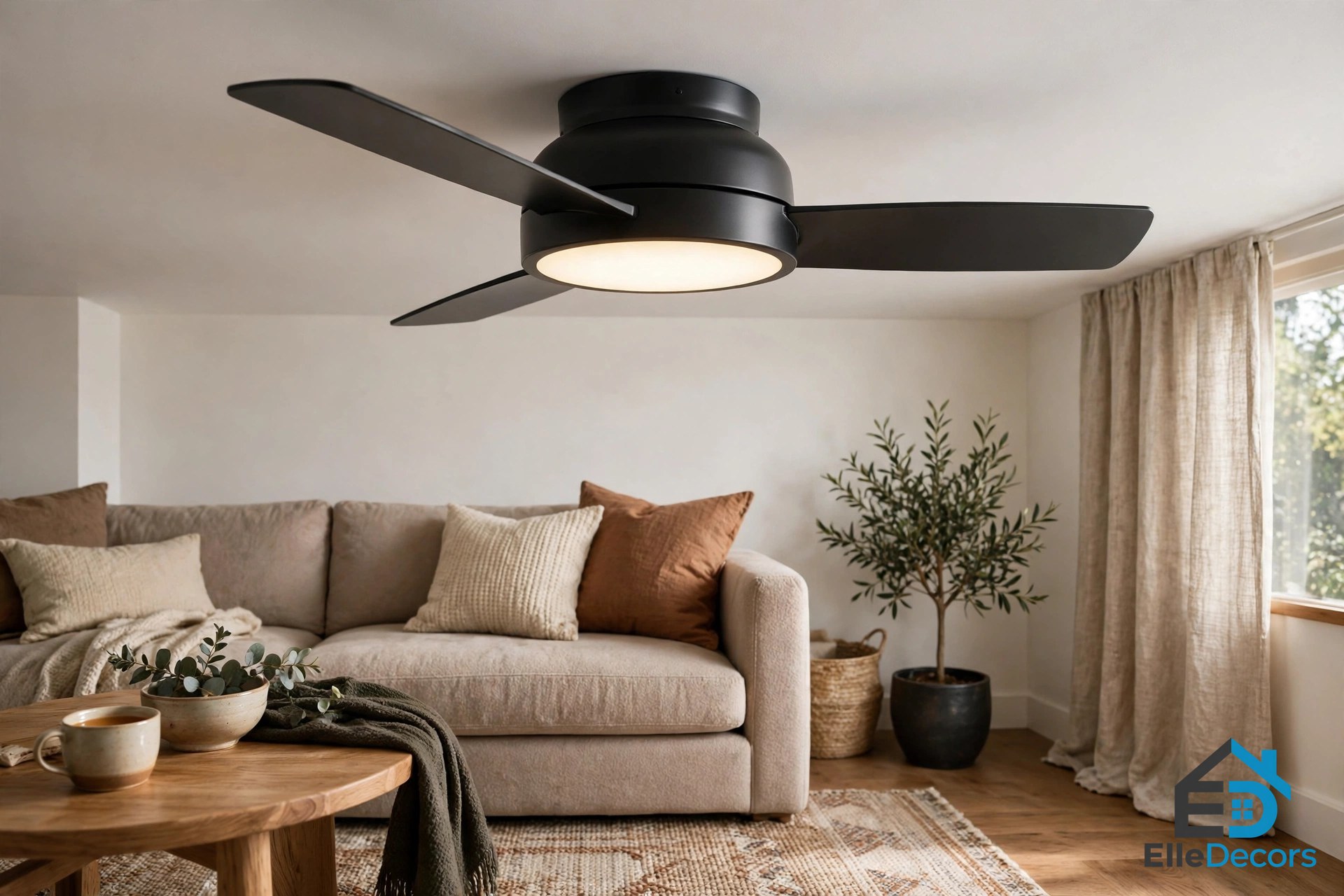
Hunter Dempsey Low Profile with Light 52
The Dempsey is the value flush mount, and the one to buy when the ceiling is under 9 feet. Hunter builds it flush against the ceiling, with a 52 inch blade span, a WhisperWind three-speed reversible motor, and fully dimmable LED bulbs included. A handheld remote is included, and the four reversible blades flip between two finishes. Pick it for a bedroom or living room with an 8 foot ceiling where a downrod fan would hang too low.
View the Dempsey Low Profile Ceiling Fan at Hunter
Hunter Cranbrook Low Profile with Light 52
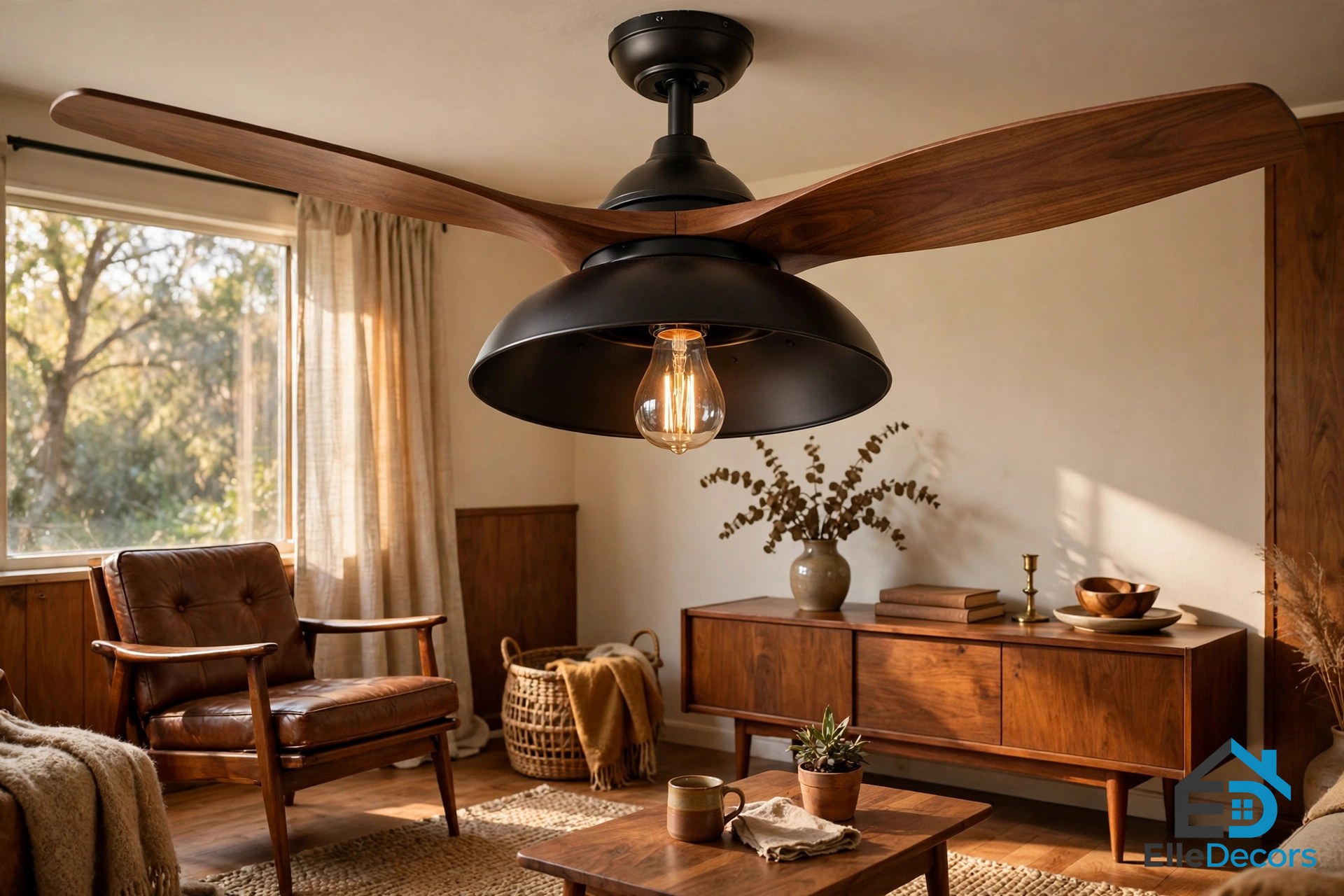
The Cranbrook is the mid-century one. Hunter calls it a tribute to a time long gone, with an open hood and tapered blades around an exposed bulb — a look that is both vintage and current. It is a 52 inch low profile fan with a WhisperWind three-speed reversible motor, an energy-efficient LED bulb, and a handheld remote.
The four reversible blades come in mid-century walnut and blonde oak, and the low profile mount suits ceilings under 9 feet. It is indoor-only, and Hunter backs the motor with a limited lifetime warranty. The same clean lines and warm woods work across an open-plan space, so pair it with mid century modern living room furniture and the whole floor feels planned rather than patched together. Pick it when you want the fan to be the room’s mid-century moment.
View the Cranbrook Low Profile Ceiling Fan at Hunter
Minka Aire Roto Flush with Light 52
The Roto Flush is the flush mount that still looks designed. Minka Aire builds it as a 52 inch hugger fan with an integrated LED light, three speeds, and a remote control, so it hugs the ceiling without looking like a builder-grade afterthought. The spec sheet lists an AC motor, 1,611.7 initial lumens, a height of 10.79 inches, and a limited lifetime warranty. Pick it when the ceiling is low but the room still deserves a fan with a point of view.
View the Roto Flush Ceiling Fan at Lightopia
The Quiet Smart Fan
Big Ass Fans Haiku L
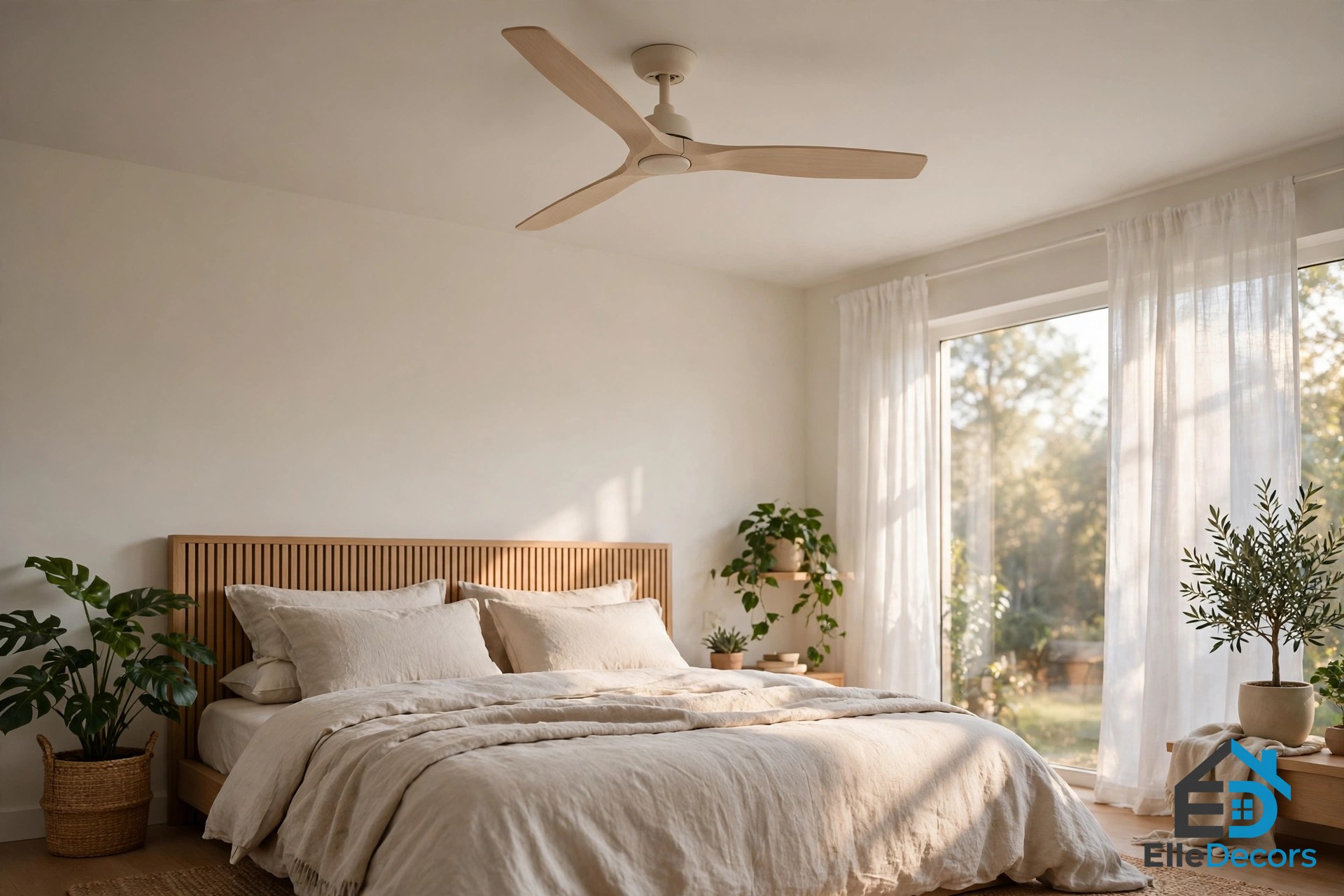
The Haiku L is the quiet benchmark at a more reachable size. Big Ass Fans builds it with three precision-balanced airfoils and a high-efficiency permanent-magnet motor, in 44, 52, and 60 inch diameters, with a 5 inch downrod included. It works with Apple HomeKit, Alexa, and Google Home, by app, voice, wall control, or remote, and carries a 5-year warranty. The 52 inch version covers a standard bedroom up to 225 square feet; the 44 inch suits a smaller bedroom or guest room. Pick it for a bedroom where silence matters most.
View the Haiku L Ceiling Fan at Big Ass Fans
Covered Outdoor Spaces
Fanimation Spitfire Indoor/Outdoor with Light 48
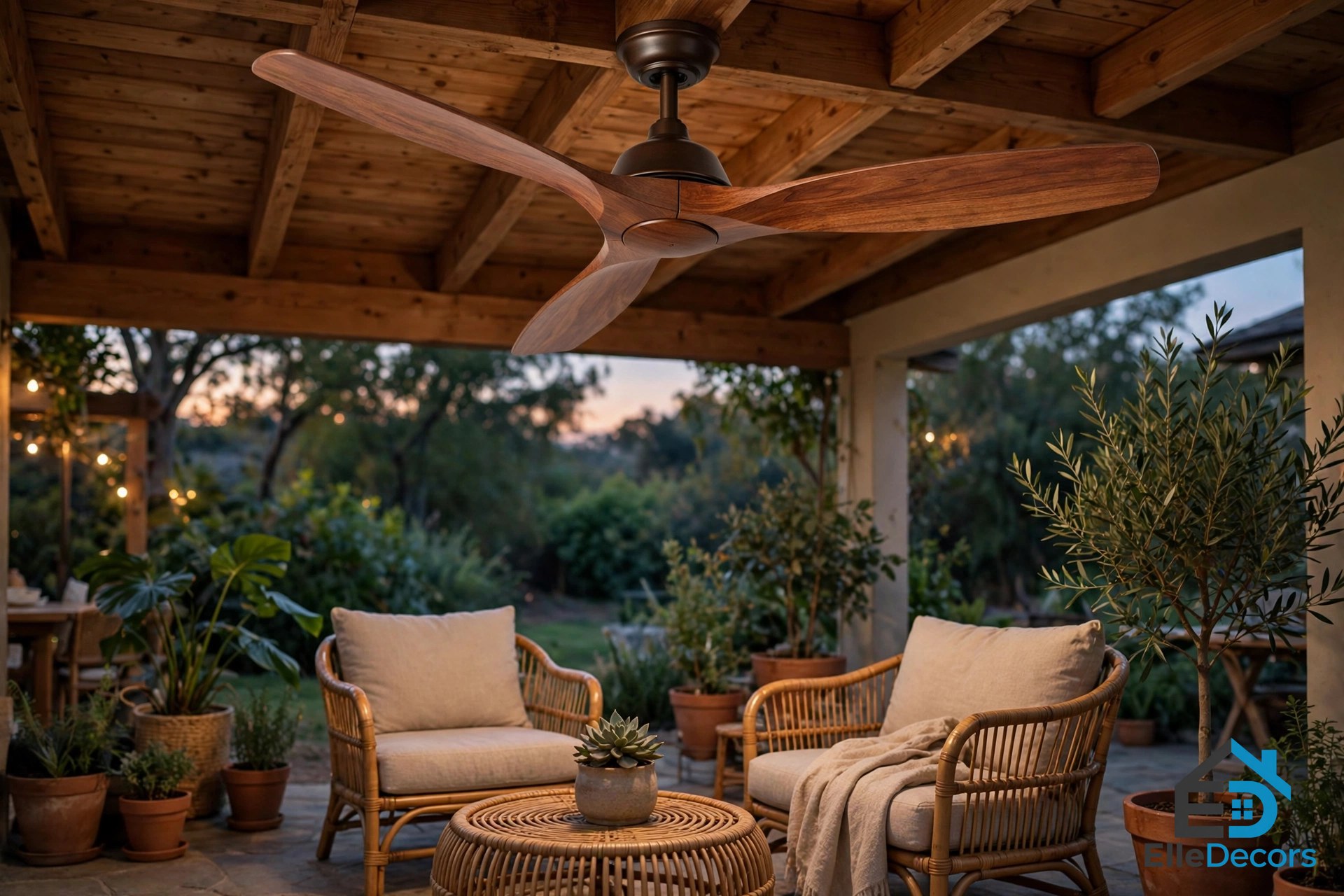
The Spitfire is the one for the covered porch. Fanimation builds it as a three-blade fan with a 48 inch blade span, an integrated LED light kit giving 1,400 lumens of 3,000K light, and a damp rating for covered outdoor areas. The spec sheet lists a 188 by 25 AC motor, a 21-degree blade pitch, a 4.5 inch downrod, and a remote. A 60 inch version is also made for larger covered spaces. Pick it when the room to cool is outside the walls.
View the Spitfire Ceiling Fan at Lightopia
The Small-Room White Fan
Visual Comfort Launceton 44
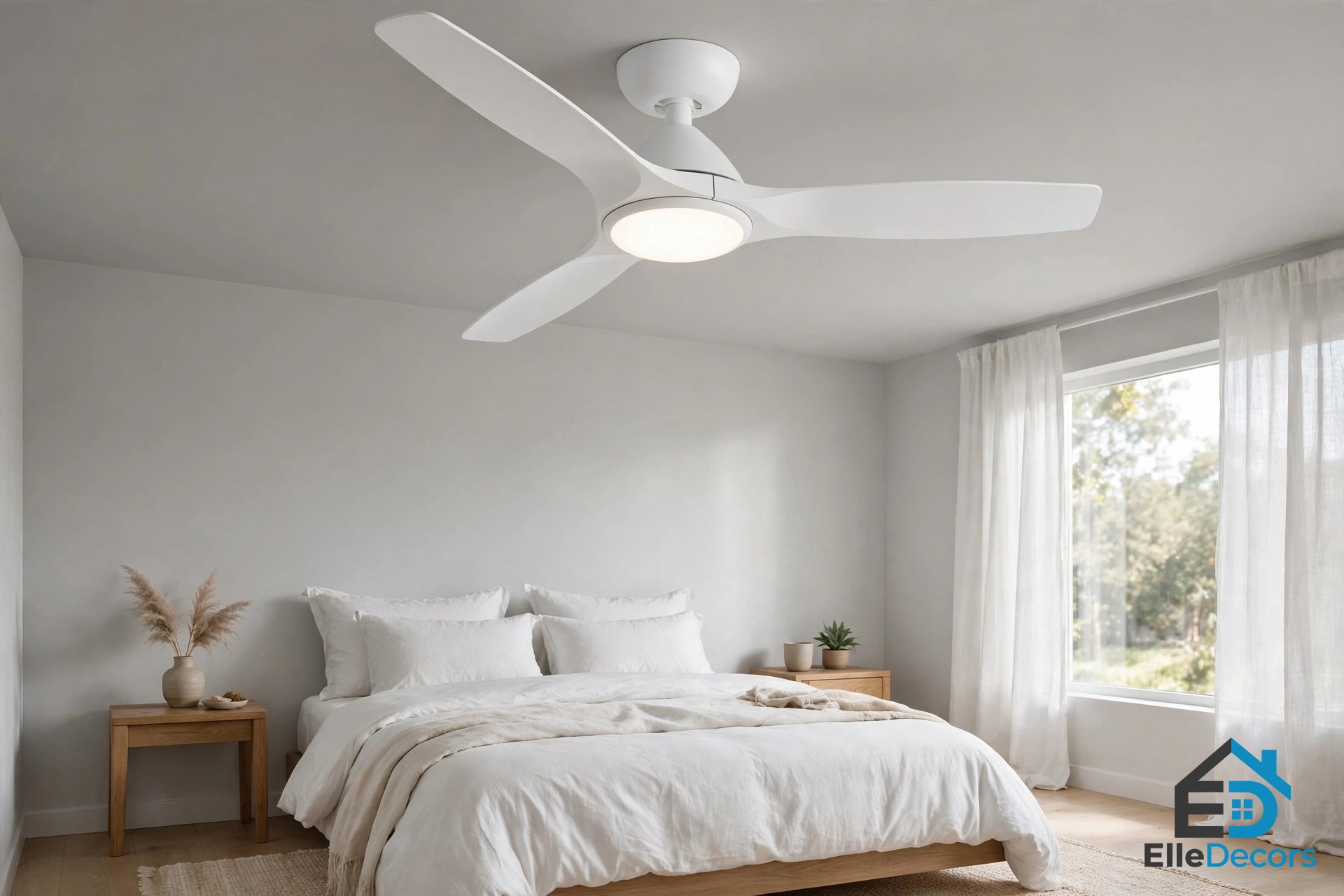
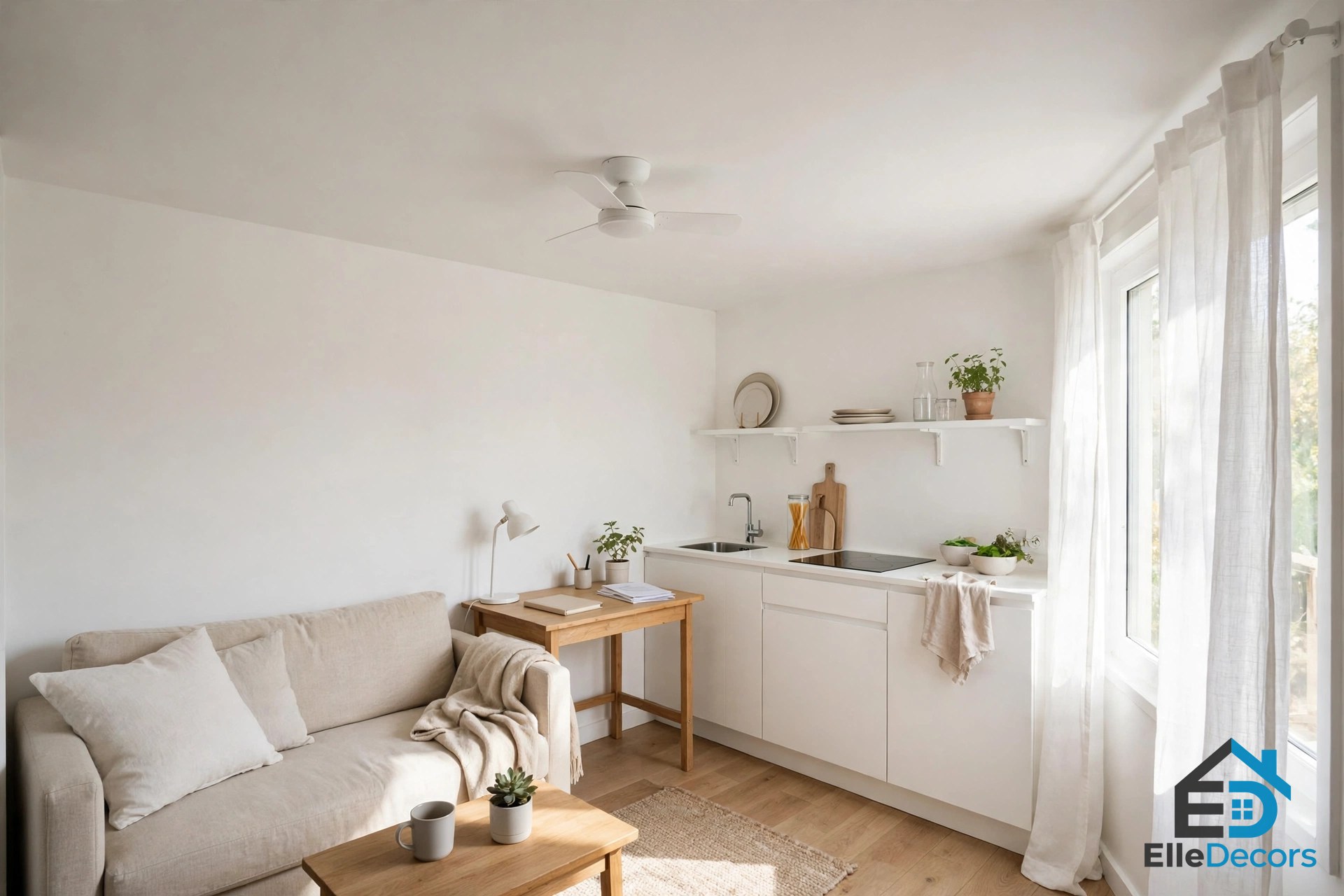
The Launceton is the fan that disappears. Designed by Chapman and Myers for Visual Comfort, it is a 44 inch fan in all matte white, with four matte white ABS blades, a DC motor, and an integrated LED. It is damp rated, and the seller lists it for rooms of 90 to 120 square feet. White on a white ceiling at the right height is close to invisible, which is exactly the point in a small room. Pick it for a small bedroom, a home office, or any room under 144 square feet.
View the Launceton 44 Ceiling Fan at Bees Lighting
Keeping the Fan Looking Good
A good fan only stays good with a little care. Dust the blades every few weeks with a damp cloth or a pillowcase pulled over each blade, which traps the dust instead of spreading it. Check the screws and the downrod once a year — a wobble almost always starts with a loose screw, not a bad motor. Run the fan in reverse in winter, so it pushes warm air back down from the ceiling.

All 8 Picks at a Glance
Use this ceiling fans contemporary comparison to narrow the list, then measure your room.
| Fan | Blade Span | Motor | Light | Best For |
|---|---|---|---|---|
| Modern Fan Co Ball Flush | 42 in | Not stated | No light kit | Sculptural minimal rooms |
| Visual Comfort Maverick 60 LED | 60 in | DC, 6 speeds | 18W LED, 1,100 lumens | Large open-plan rooms |
| Hunter Dempsey Low Profile | 52 in | WhisperWind, 3 speeds | Dimmable LED included | Low ceilings, value |
| Hunter Cranbrook Low Profile | 52 in | WhisperWind, 3 speeds | LED bulb included | Mid-century rooms |
| Minka Aire Roto Flush | 52 in | AC, 3 speeds | Integrated LED | Low ceilings, designed look |
| Big Ass Fans Haiku L | 44, 52, or 60 in | Permanent-magnet | Not stated | Quiet bedrooms, smart homes |
| Fanimation Spitfire | 48 in | AC | LED, 1,400 lumens | Covered outdoor spaces |
| Visual Comfort Launceton 44 | 44 in | DC | LED included | Small rooms, white ceilings |
Watch: Choosing the Right Size
Watch Capitol Lighting’s guide to choosing the right ceiling fan size — room size, blade span, and hanging height with real rooms. It is a sizing guide, not a shopping video.
Video: Capitol Lighting explains how to choose the right ceiling fan size.
Frequently Asked Questions
Are ceiling fans contemporary in style still worth buying?
Ceiling fans contemporary designs are worth buying when the fan fits the room. A contemporary fan moves air for far less energy than air conditioning, it doubles as the room’s light with an integrated LED, and current designs — three blades, matte finishes, slim DC motors — no longer look like the builder-grade fans that gave ceiling fans a dated reputation. The value is in the fit: right size, right height, right rating.
What size fan do I need for my bedroom?
A bedroom of 76 to 144 square feet takes a 36 to 44 inch fan, and a main bedroom of 145 to 225 square feet takes a 44 to 50 inch fan. Choose a DC motor fan with a remote and either no light or a dimmable one, and centre it over the foot of the bed when the room allows it, so the draft crosses the bed instead of blowing onto your face.
Do I need a light kit on my ceiling fan?
Only if the room has no other ceiling light. A room with downlights or lamps is better served by a fan with no light kit. A room with exactly one ceiling box needs the fan to carry the light, so choose an integrated dimmable LED and check the colour temperature first.
Should I run my ceiling fan in winter?
Yes. Run the fan in reverse in winter, so it pushes warm air back down from the ceiling. Dust the blades every few weeks with a damp cloth or a pillowcase pulled over each blade, which traps the dust instead of spreading it, and check the screws and the downrod once a year — a wobble almost always starts with a loose screw, not a bad motor.
Why does my ceiling fan wobble?
A wobble almost always comes from the install, not the motor. Check that the bracket is tight, the downrod is secure, and the blades are level and evenly weighted, then tighten the screws and check the canopy before assuming anything is broken.
The Bottom Line
The right fan disappears into daily life: it cools the room without a sound, lights it without a glare, and looks chosen for the room rather than bolted on. Start with size, then pick the ceiling fans contemporary look that fits your room and your habits — a sculptural ball, a 60 inch Maverick, a flush mount, a quiet Haiku. Measure twice, check the rating, and the fan will be the piece your ceiling never had to apologise for.